
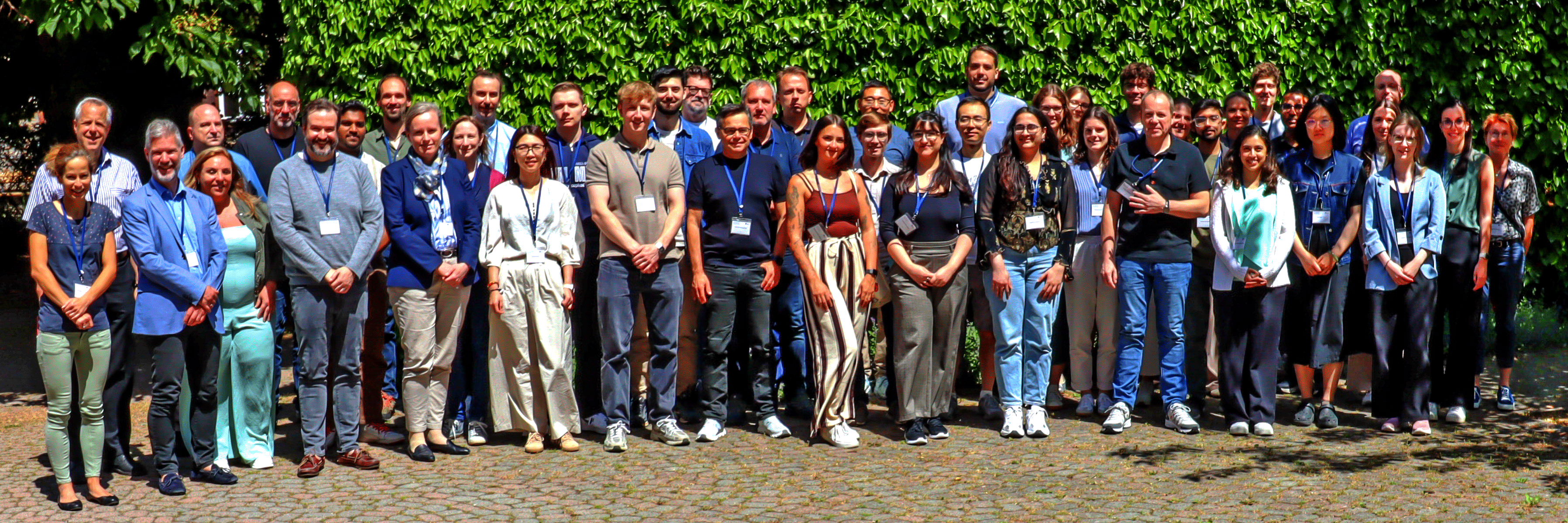
Fifth Annual Retreat of the CRU 5002 at Drübeck Monastery
The fifth annual retreat of the CRU 5002 took place at Drübeck Monastery from May 29 -30, 2026. On two very busy days, the members of our consortium used the opportunity afforded by the event to network, exchange ideas, forge or deepen both new andold collaborations, and plan future research.
Day 1 started with progress reports from the Central Projects, providing an update on the establishment and molecular characterization of patient-derived PDAC models and clinical and research data management with the CRU 5002. Christoph Ammer-Herrmenau reported on the current state and the crucial developments of the MolPAC Program, an essential prerequisite for the CRU 5002's success.
The focus of this year’s retreat was the translational of research findings accomplished in the CRU 5002 into clinical practice. Consequently, two sessions were dedicated to that topic. We heard about most recent developments of local clinical trials focusing on PDAC. Further, our session "Supporting Local Structures and Developments in the PDAC Landscape" featured presentations on the molecular tumor board (Nelia Nause), as well as updates on the UMG Accelerator from Günter Schneider, Shiv Singh, and Matthias Wirth. The session concluded with a presentation on the Drug Development Platform by our invited guest, Prof. Dr. Lutz Ackermann from the Institute of Organic and Biomolecular Chemistry at Georg-August University Göttingen.
Potential application of these structures for our consortium were then discussed in the session “Translational potential from the Consortium”. Herein, every individual CRU 5002 project pitched and discussed concepts and ideas how scientific findings from SP1-SP8 can be translated into clinical application. In the upcoming two years, we will build on and further develop these ideas in order to achieve the CRU 5002's overarching aim to exploit genome dynamics for better treatment options for pancreatic cancer patients.
Day 1 of the retreat concluded with a virtual and very inspiring keynote lecture KRAS Inhibition for Cancer and Pre-Cancer from Prof. Dr. Ben Stanger, Director of Penn Pancreatic Cancer Research.
Day 2 encompassed progress reports from each subproject. The retreat also featured a poster session, in which the trainees from each group presented their research. Within the poster session we had a very lively exchange of conceptual ideas and experimental and methodological approaches. This year’s Best Poster Award, awarded for the first time by popular vote, was won by Nehir Sahin of SP2. We congratulate Nehir on winning the award in her first year as a PhD candidate!
The discussions and exchange during the sessions, over coffee and barbecue will help shape the consortium's future research activities. We are already looking forward to reconvening at the next retreat in 2027.